
Changes in the academic curriculum lead to more engaging courses for students and a new credit structure that is being used at top liberal arts institutions across America.
By Megan Z. Shearin | September 29, 2010
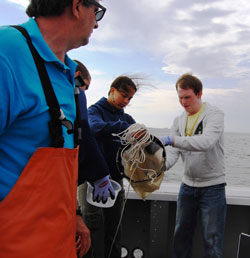 Students at Virginia Wesleyan College will soon be learning under the same curricular model that is being used at top liberal arts institutions across America.
“Each course will be transformed, every department will refashion its major and every faculty member will rewrite his or her courses,” Vice President for Academic Affairs Dr. Timothy O’Rourke said during the campus-wide community council meeting on Friday, Sept. 17. “This will be a transformative curriculum that is more demanding and engaging, and will set Virginia Wesleyan apart from many other colleges.”
The new 4-credit course structure will be fully implemented fall 2011. A typical semester schedule will consist of four 4-credit courses, instead of the current five 3-credit courses. Students will take eight courses per year and 32 over four years, for a total of 128 credits. Most of the top liberal arts colleges, ranked by U.S. News and World Report, are using the 4-course/4-credit structure.
The change means that students will take fewer, but more in-depth courses. Active learning will be specifically integrated into each course to increase engagement and allow for hands-on experiences. While some classes may meet for four hours a week in the classroom, others may meet all together for only three hours each week in the classroom. The fourth academic credit will provide for out-of-class guided, independent exercises.Since 2007, Virginia Wesleyan’s dynamic and committed faculty members have been working hard to transform courses and majors as part of curricular reform. Most of the top liberal arts colleges, ranked by U.S. News and World Report, are using the 4-course/4-credit structure, which Virginia Wesleyan plans to be fully implemented by fall 2011.
This continuous improvement will provide for more real world experiences such as the “Shelter Course” offered during Winter Session. Held on campus each January, students combine their sociology course work on the societal impacts of homelessness with active learning through involvement in a week-long homeless shelter.
“It’s great to see that many of our faculty members are already teaching courses enhanced with field experiences, service learning, and other experiential learning activities,” said Dr. Lisa Carstens, Professor of English and Associate Dean of Inquiry-Guided Learning. “We want to see more of that. This new structure will emphasize cutting-edge learning components that will be infused throughout the entire curriculum.”
During the community council, Associate Dean for Special Academic Projects Debbie Hicks announced that the three-week Winter Session held in January would still be offered under the new credit structure, but it would be extended by two days to support more learning. Hicks also presented a recommendation of the addition of 2-credit elective courses that would start during mid-semester.Continuing students who are currently enrolled will not be delayed by the curriculum change. Those students will complete their degrees on schedule under the existing 120-credit hour graduation requirement.
“These electives would give students more flexibility in their schedule and compensate for the dropping of a course,” explained Hicks. Career development, study abroad and internship preparation were three course topics she cited as elective examples.
During the meeting, O’Rourke emphasized that the curriculum changes would have no effect on tuition or majors offered at the College, nor would it delay the progress of continuing students. Students currently enrolled will complete their degrees on schedule under the existing 120-credit hour graduation requirement.
“I will tell you that we’re going to have to work harder, all of us, to make this happen,” he said. “Students will also have to work smarter and be more engaged.”