
A conversation with Dr. Timothy O'Rourke explores citizenship, self-government and the value of constructive disagreement
University News | September 17, 2026
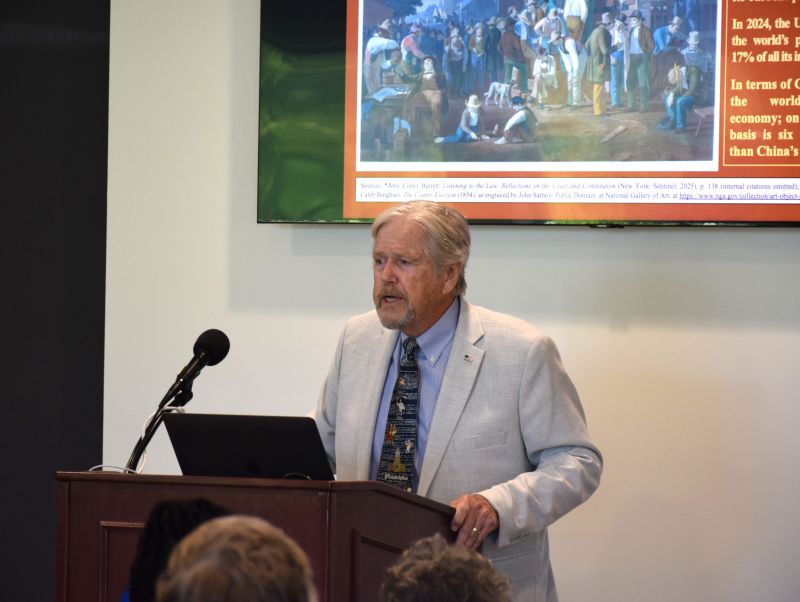 As the United States marks Constitution Day and Citizenship Day on September 17, Batten University welcomed former Vice President and Provost Dr. Timothy G. O’Rourke back to campus for a conversation about the nation’s founding documents and their continuing relevance to American civic life.
Hosted by the Robert Nusbaum Center, O’Rourke’s Constitution Day presentation, “The Founders Can Still Help Us Find Our Way,” examined what the Declaration of Independence and the U.S. Constitution can teach Americans about citizenship, self-government and finding common ground.
September 17 commemorates the signing of the U.S. Constitution in Philadelphia in 1787. The Constitution was signed by delegates following months of debate and compromise and established the framework for the federal government.
With the nation celebrating its 250th anniversary, O’Rourke considered how the founding documents continue to provide a framework for addressing the challenges of American democracy.
“The Declaration of Independence and the U.S. Constitution—read in their entirety and taken together—established a firm, if imperfect yet amendable, foundation for our first 250 years,” O’Rourke noted.
For O’Rourke, the documents remain relevant not because they provide simple answers to contemporary challenges, but because they establish principles and structures through which citizens can work through disagreements and respond to changing circumstances.
“They remain a dynamic covenant for meeting America’s recurrent challenges,” he said, “but only to the extent that ‘We the People’ ‘pledge’ ‘our lives’ and ‘sacred honor’ to the principles that these documents embrace.”
The Constitution itself emerged from significant disagreement among the delegates who gathered in Philadelphia. They debated questions ranging from the balance of power between the national and state governments to representation and the structure of the new government. Their deliberations ultimately produced a new framework built through negotiation and compromise.
That history provided an important backdrop for O’Rourke’s discussion of contemporary civic life. Drawing on the work of author and political thinker Yuval Levin, he emphasized the Constitution’s potential to provide a framework in which disagreement can be productive.
“As a framework for unity,” Levin observes, “the Constitution functions as a means of rendering disagreement more constructive.”
The idea is particularly significant on Constitution Day, when attention turns not only to the document itself but also to the responsibilities of citizenship. Constitution Day and Citizenship Day recognize both the formation and signing of the Constitution and those who have become citizens through coming of age or naturalization.
O’Rourke brought extensive experience in constitutional history, political science and civic engagement to the discussion. He earned his Ph.D. in political science from Duke University and served as Vice President and Provost at Virginia Wesleyan University from 2007 to 2019. His academic career has included teaching and scholarship at Campbell University, the University of Virginia, Clemson University, the University of Missouri–St. Louis, Salisbury University and Batten University.
His work has focused in part on connecting higher education with communities and encouraging citizen engagement in the political process. He has testified on redistricting before federal courts and Congress and has written on voting rights for the Virginia Law Review, University of Richmond Law Review and Political Geography. He also previously directed the Virginia Commission on the Bicentennial of the U.S. Constitution and Kids Voting Missouri.
Through the Constitution Day presentation, O’Rourke invited the Batten community to look to the nation’s founding documents not simply as historical artifacts, but as part of an ongoing civic conversation—one that requires citizens to understand the principles of self-government, engage with differing perspectives and participate in the work of sustaining a constitutional democracy.
The National Archives similarly describes Constitution Day as an opportunity for Americans to learn more about the Constitution and government through civic education and engagement. At a moment when the United States celebrates 250 years, the Constitution Day conversation offered an opportunity to reflect on both the accomplishments and continuing work of American self-government—and on the role each generation plays in carrying that work forward.
O’Rourke suggested that "We the People" could “choose to act better.”
“Turn off the phone, get a group, read a newspaper, embrace civility and persuasion, and revisit and recover our story.”