

By Megan Z. Shearin | August 11, 2010
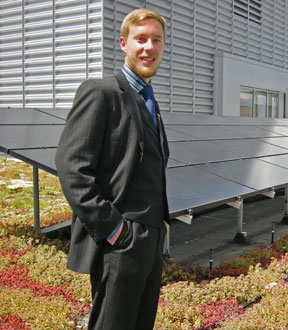 This summer, Virginia Wesleyan senior John Maravich is researching the future of electric cars as a paid intern with the U.S. Environmental Protection Agency (EPA) Region 8 office in Denver, Colo.
Recipient of a prestigious Greater Research Opportunities (GRO) Undergraduate Fellowship, Maravich is working in the Infrastructure Division. This 23-member division is responsible for greening and environmental sustainability of all design, construction, engineering, operations and maintenance of the Region 08 EPA, which includes everything from fleet vehicles to facilities.
A double major in Earth & Environmental Sciences and History, Maravich is researching which electric vehicle the division should add to its fleet. He has specifically focused on three models: the soon-to-be released Chevrolet Volt, the Ford Focus electric vehicle, and the upcoming Tesla S, an all electric vehicle produced by Tesla Motors in California. As part of the project, he was tasked with investigating the appropriate integrated design feature, or facility constructed charging station as the Society of Automotive Engineers recently adopted a new standard plug for all electric vehicles.
Maravich’s research is part of a nationwide movement to reduce America’s dependence on foreign oil and develop energy efficient technologies for transportation. In March 2009, President Barack Obama announced $2.4 billion in funding under the American Recovery and Reinvestment Act to support next generation electric vehicles in an effort to develop electric cars and batteries in the United States. While electric car technology has been around for years, they have yet to be mass marketed due to high costs and battery-related issues such as low driving range, recharge time and battery replacement expenses.
“I have greatly enjoyed the projects I have been working on this summer at my EPA internship,” said Maravich, who is a native of Virginia Beach, Va. “The staff is friendly and extremely helpful in my research endeavors.”
More than 150 undergraduate students applied for GRO Fellowships, and Maravich was one of 34 students selected, based on academic merit and intended research in an environmentally related field of study. Students awarded GRO Fellowships receive financial support for their junior and senior years of undergraduate study and for an internship at an EPA facility during the summer prior to beginning their senior year.While in Colorado, Maravich had the opportunity to attend the annual Aspen Environment Forum, a four-day event discussing issues from climate change to renewable energy policy, and technology innovation to natural resource conservation. “I met some of the most brilliant minds in the environmental movement at this event, and it was probably one of the best experiences I have ever had,” he said.
Students at Virginia Wesleyan, like Maravich, have become accustomed to conducting undergraduate research as part of their College academic experience. In just three years, Maravich has completed three different research projects ranging from mercury runoff in green roofs, geologic surveys in Virginia and Pennsylvania in the 1830s, to greenhouse gas emissions inventory. In 2009, he was awarded the College’s first summer undergraduate research fellowship through Virginia Wesleyan’s STIHL Incorporated Endowment for Undergraduate Research. He is the third Virginia Wesleyan student to receive the EPA GRO Undergraduate Fellowship.
A member of the Honors & Scholars Program, Maravich said these in-depth projects have given him the opportunity to explore topics that interest him the most.
“My undergraduate research projects have allowed me to explore future career paths and have greatly enriched my education by giving me hands-on experience that classroom work alone cannot replicate,” he said.
During his EPA internship, Maravich has also conducted cost analysis for upgrading the compact fluorescent light (CFL) fixtures to light emitting diode (LED) fixtures in the Denver office. His core independent research project is focusing on the external environmental impacts of renewable energy technologies, such as issues associated with mining the metals necessary for the manufacture of photovoltaic systems and wind turbines.
Maravich’s time outside of his internship is spent exploring the many adventures of the Mile High City. He has taken a number of weekend trips to places such as Pike's Peak on the Cog Railroad; sampled the spring waters in Manitou Springs; hiked in shorts through Rocky Mountain National Park when there was still three feet of snow on the ground in May; climbed the highest sand dune in North America at Great Sand Dunes National Park; toured an art museum and eaten at restaurants throughout Denver.