
Tyler Noll’s award-winning composting research is helping lay the groundwork for a campus initiative designed to grow beyond the bin
University News | September 16, 2026
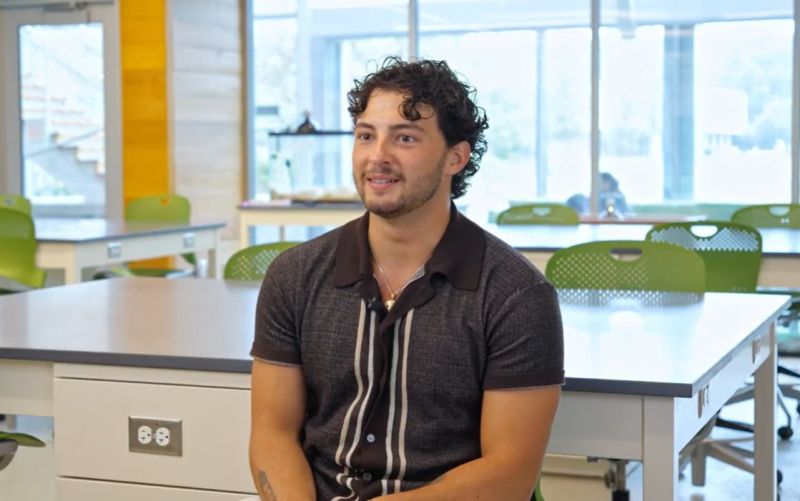 For recent graduate Tyler Noll ’26, a research project that began with an experience halfway around the world has evolved into something much bigger: a framework for creating a culture of sustainability on campus. Noll, an environmental studies major with a minor in earth and environmental science from Mechanicsburg, Pennsylvania, was awarded the 2026 Ryan Environmental Prize for Excellence in Research during the fourth annual Louis and Prudence Ryan Environmental Research Symposium on April 30.
His presentation, “Implementing a Campus Composting Program Framework to Advance Sustainability at VWU and Beyond,” examined how the University could develop a successful campus composting program—not simply by providing compost bins, but by building student engagement, education and community partnerships into the initiative.
Now, that research is moving from the page on to the campus.
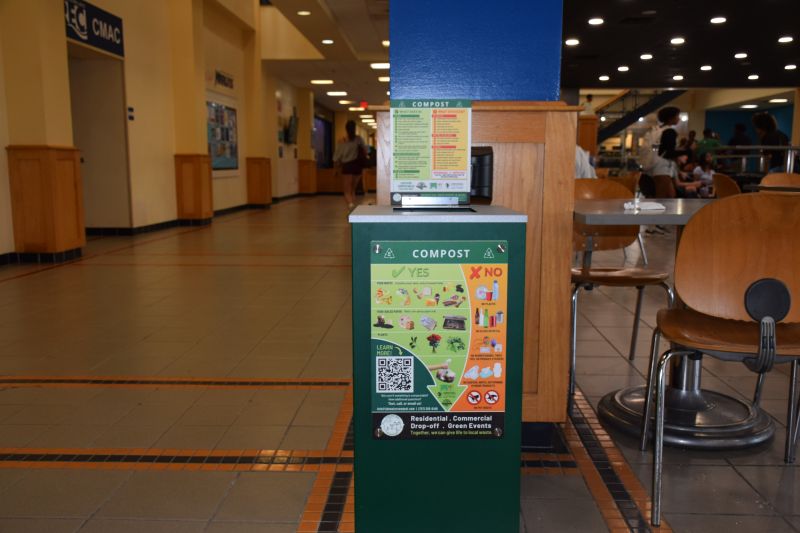
A pilot composting program is getting underway this semester, with an initial focus on strategically placing collection bins in locations where they can have the greatest impact. Data gathered from the pilot will help inform future decisions about bin placement, contamination and educational efforts. The long-term goal is ambitious: expand the program throughout campus and ultimately establish a composting collection system that reaches virtually every room at Batten University.
From Morocco to a campus solution
The inspiration for Noll’s research began during a study abroad experience in Morocco. While leaving his university campus after lunch one day, Noll stopped in a nearby village for coffee. As he sat enjoying his drink, he noticed a young boy searching through a trash can for food.
“That really stuck with me,” Noll recalled.
When he returned to the United States, Noll began noticing the amount of food being discarded in the University’s dining hall. He thought about the young boy he had encountered in Morocco, as well as people he had met during travels in Morocco and Chile who were experiencing food insecurity.
“I thought back to that little boy and the hundreds of other people that I saw from all my travels in Chile and Morocco that had food insecurity,” he said. “And seeing us waste so much here with this very linear system encouraged me to do something about it.”
Noll began working with Professor of Ocean and Atmospheric Sciences and Director of Sustainability Dr. Elizabeth Malcolm to explore how he could address food waste through his Batten Honors College capstone project. When he learned about a University grant focused on reducing methane emissions, he saw an opportunity to connect that work with the possibility of a campus composting program.
His research included examining what other universities of similar size were doing and studying case studies and literature about successful composting programs. He discovered examples of student-run campus gardens that supplied food to dining halls and universities that partnered with local farms to make use of the compost they generated. Those examples helped Noll develop a framework that the University could use as a roadmap.
“I created a framework to have our university be able to look through and kind of go through a checklist,” he explained. “It’s just sort of as a brainstorming tool for what can we do here to make our composting efficient and make it a culture on campus, not just a bin that you put your food into.”
 Building a culture, not just a collection system
For Noll, successful composting requires more than infrastructure. Education is one of the central elements of his framework. His research found that contamination—when materials that cannot be composted end up in compost bins—is a significant challenge for universities.
“When the education aspect isn’t fully implemented, then you have students who just don’t know what they can and cannot compost,” Noll said. “And then the wrong thing gets put somewhere, and it slows the efficiency by so much.”
His framework therefore emphasizes ongoing awareness through signage, social media, classroom presentations and first-year student orientation. The pilot program beginning this semester will provide an opportunity to test those strategies while collecting data about how the system is working. The initial focus will include the dining hall, where students can dispose of unfinished food, as well as areas where much of the University’s organic waste is generated, including food preparation areas.
The program will monitor how much organic material individual bins receive and how much contamination they contain. That information can then be used to adjust the system.
“If a bin doesn’t have very much organic material in it at all,” Noll explained, "it could be moved to a more effective location. If another bin has a high level of contamination, additional signage or education could be added nearby."
Imagining what comes next
While the pilot begins with practical questions about where bins should go, Noll sees a much larger possibility for the future. One of the ideas that excites him most is the development of campus gardens that could use the compost produced through the program.
“I just imagine a student waking up in the morning and walking to class and instead of heading into a classroom with four walls and a projector, they walk into our campus garden,” Noll said.
He envisions students tending plants they started from seed, conducting research on how compost affects plant growth and using those experiences as opportunities for hands-on learning.
“Those kind of things matter,” he said. “That kind of research is really empowering for a student and allows them to be leaders in sustainability in the community and in global problems, local problems that are serious like food insecurity.”
That vision also connects environmental sustainability with the needs of the surrounding community. Noll points to the fact that food insecurity is not simply an issue found in distant countries. It exists close to campus, too.
“This is something that’s real and local,” he said, noting that community gardens and food production could potentially help address food insecurity just minutes from the University.
A project designed to outlast its creator
Noll graduated before the initiative could be fully implemented, but that was not necessarily a disappointment. Instead, he sees the project as something he can leave behind for other students to develop.
“It’s bittersweet graduating, but as I’m graduating, I am really thankful that my project got this far,” Noll said.
The response to his research at the Ryan Symposium gave him an early indication that other students were ready to take ownership of the idea.
“I got so much positive feedback from community members, from the judges, from faculty at our university, and from students,” he said. Some students even asked whether the University might one day have campus gardens and said they would like to participate.
Noll believes the Marlins Go Green Club will play an important role in carrying the work forward.
“Our original composting program that we have on campus, they built with, you know, planks and nails and hammers in the parking lot,” he said. “So I know that they’re determined individuals and I’m really excited to see what they do with the composting framework that I’ve created.”
The next stage of the initiative could eventually bring composting into the Jane P. Batten Honors College, where students have full kitchens and could contribute food scraps from their own cooking.
From there, Noll hopes the program can continue expanding.
“The goal, I guess, one day is to have a composting collection system for pretty much every room in Batten University,” he said.
From a class project to a lasting possibility
Noll never expected his Honors capstone to develop into a campus-wide sustainability initiative—or to earn the Ryan Environmental Prize.
“This experience of creating a composting framework and something that started as a cool idea and sort of a project that would get me a good grade in a class turned into something, you know, possible and plausible, something exciting and kind of like blossoming,” he said.
He describes the framework as “a baby” and, importantly, as a platform that future students can continue to shape.
“Anybody can look at it and say, ‘Wow, these are great ideas. Let’s try these,’” Noll said. “And hey, I have some ideas. Let’s add these and then try these.”
That openness is central to Noll’s vision for the project. He hopes future students will not simply follow his framework but will build upon it with ideas of their own.
“As I’m graduating, it is sad to leave sort of something like this behind because I was really excited creating it and it’s something I’m very passionate about,” he said. “But at the same time to give sort of this seed to say to younger students that are equally as passionate as me and have four years ahead of them to do amazing things with that, I’m really excited to see what they can do.”
Noll hopes to return to campus one day and see how far that seed has grown.
“I’m excited to return to the university one day to see some campus gardens and compost being used in the labs and things like that,” he said.
Carrying the work forward
As the composting initiative enters its pilot phase this semester, Noll’s research is taking on a life beyond its original purpose as an Honors capstone. The project now belongs to the campus community—students, faculty, staff and future Marlins who will have the opportunity to test ideas, learn from the data and continue expanding the program.
For Noll, that is the most meaningful outcome of all. His research began with a moment of witnessing food insecurity in Morocco and evolved into a question about what could be done differently at home. It led to a framework for reducing food waste, educating the campus community and potentially creating new connections among sustainability, hands-on learning and food security. And now, as the work continues, Noll’s project is no longer just an idea.
It is a beginning.