
Spring Breakin’ It, Alternative Style
Lan Tran '10 blogs about her environmental community-based service projects with the Chesapeake Bay Foundation through Wesleyan’s Alternative Spring Break Program.
 Imagine, Wesleyan’s Alternative Spring Break Program, places teams of students in communities to engage in student-led service projects that focus on volunteerism and education. This week, senior Lan Tran and eight other Virginia Wesleyan students are working with the Chesapeake Bay Foundation. Students are installing fencing around the Dunes at Fort Story, planting Wax Myrtles at the Hermitage Museum & Gardens, cleaning up Kiptopeke State Park in Cape Charles, Va., and ending their trip with a cleanup on the James River.
Dune Restoration
March 15, 2010
To start off our alternative spring break, the Virginia Wesleyan Imagine Team spent the day at the beach! There was singing, digging, rolling, running, story-telling, and laughing. The sand stuck on our wet feet and between our toes. The sun was shining brightly the whole time behind the thick monochromatic layer of clouds from horizon to horizon. Birds flew in place into the wind that pushed waves against the shore.
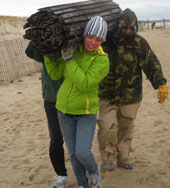
Wrapped in layers of clothing and rain coats, we dug a hole every ten feet along the bottom of the dunes, rolled out stretches of fencing, and secured them to the poles we had just set up. Our rain-soaked shoes sank into the sand with every heave. Every now and then, we looked up toward the speck of our starting point. Today was the beginning of our sand dunes restoration on the shore of the Chesapeake Bay.
The site was a distortion of the usual beach scenery. Construction scrapers were hauling sand around and removing the foundation of an old building. Roots of the grass were exposed at the edges of the dunes. Rusted spray paint cans, candy wrappers, plastic bottles, and soda cans scattered the coast. We were shocked by the amount of waste. They were common items that people used for only a moment and will last a millennium.
I do not believe that only the people eager to make a difference, as those I worked alongside today, can feel the state of their surroundings. Imagine that the people beside you would do something good for those in front of you.
A Cleaner Beach
 March 16, 2010
The wind was very strong today, but we were even stronger. Walking in a line just out of reach of the high tide and waves, sometimes skipping inland to avoid soaking our shoes, we carried supplies in our arms or on our shoulders to where we had finished off yesterday. Having experienced yesterday’s drench, the ride to Fort Story was quiet. I felt like we were all mentally preparing for whatever the weather had set for us. Since this was our second day there, we arrived at the beach with a clear vision for the action plan. It didn’t take us long to warm up. Together, we met our goal faster than expected. To finish off for the day, we picked up the trash on our way back. It was nearly half a mile of dune restoration in two days, and I was happy to see a much cleaner beach when we departed.
The Hermitage Museum & Gardens
March 17, 2010
The Hermitage Museum & Gardens is twelve acres of unknown magnificence. Surrounded on three sides by the Lafayette River, the beauty is in the trees, flowers and bird calls from all around. To acquaint us with our volunteering stations, we were given a little tour, which included the history of the William and Florence Sloane house from 1908 when it was a five-room summer home to forty-two rooms by 1936.
Our volunteer experience today was quite unusual. For about an hour this morning, photographers, video camera crew, and reporters from The Virginia Pilot and Channel 13 News recorded us planting wax myrtle and yaupon holly along the banks of the Lafayette River. We felt self conscious as their cameras pointed at our muddy dilapidated shoes forcing the shovel into the soil, holding the microphone as close as possible to the hole for the sound of rich earth parting each time the shovel went down. Some of us were also interviewed.
Despite pausing frequently to share information about ourselves to the press, we accomplished and learned a lot. Planting trees helps prevent erosion because the network of roots naturally holds the soil together. Also, wax myrtle and yaupon holly are native to the area, like most of the plants at the Hermitage Gardens, so they are well adapted to the climate, wild life, and geography here. Their flowering seasons match with the needs of migrating birds, which in turn disperses the seeds after feeding on the fruits and dropping the seeds elsewhere. In order to survive, plants in this wetland must be well adapted to the sandy soil and frequent changes in salinity due to tidal water fluctuations.
Most of the time, I forget that I am on spring break or that I am volunteering my time. The reporters liked to ask us why we decided to give up our spring break to get muddy and ache the next morning from using muscles we rarely use. I think we all agreed that none of us gave up our spring bring break. We get to meet new people, have fun, and do lasting good.
Kiptopeke State Park
March 18, 2010
We stayed at Kiptopeke State Park last night. This morning we met park rangers Richard, Daniel, and Sam, who had a trailer full of elderberry, button bushes, wax myrtle, magnolias, and arrowheads for us. The plants mainly serve as natural barriers to roadway activities. Also, the park is home to many birds and animals. Bird watchers like to come and enjoy a scenic experience in the park.
Richard taught us lot about the plants and planting: buttonbushes grew in the shade; wax myrtle can do well in many types of conditions, including the very wet, sandy soil we have here. Besides the wax myrtles on the dunes along the road, we tried to imitate nature by randomly digging holes in the field, and patted the roots of the young plants in place. Years from now, when we return to the park, the plants will be taller than us. How amazing that will be!
In the afternoon, we went out to clean the beach. When we finished picking up trash, we attempted to pull an old fishing net from the water. A lot of it was buried under the sand, and the task was hard because the net was so long and heavy. Sarah went shoulder deep to try and reach the other end of it, but we had to cut it from the chains and drag in what we could, leaving one buoy to mark the location for future attempts when the water is warmer.
Besides all the activities we’ve been up to during the daytime, we have had plenty of time to relax in the evenings. Already, I’ve learned how to play Balderdash, ABC, Phase 10, and (Star Wars) Monopoly. We also played Charades and Zoo, but I laughed too hard and didn’t and get very far in Zoo.
Volunteering is a wonderful opportunity to meet people you wouldn’t regularly run into, even at a College as small as Virginia Wesleyan. How does a group of students studying the environment, international relations, Spanish, art, and some undecided come together for spring break? It must be that we all have the common desire to do good for ourselves, those around us, and our future.
Platinum LEED Certified Rice Center
March 19, 2010
Our week lightened up tremendously. We went from chilling in the winds at Fort Story to tanning along the banks of the James River. This morning, we travelled from Kiptopeke to the Virginia Commonwealth University (VCU) Rice Center and did our final group cleanup.
After lunch we got a tour of the Platinum LEED Certified Rice Center. This building uses a geothermal heating and cooling system. The constant underground temperature warms water pumped through during the winter and cools water during the summer. The water circulates through the foundations of the building to minimize heat exchange between the inside and outside of the building. Most of the building is constructed with local or recycled materials. The carpeting in some of the rooms is made from plastic bottles.
We walked into a room and were surprised that no lights were on. As everyone squinted at the bright rectangles above, we learned that lenses in the ceiling scattered sunlight around the room. At night, electricity powered lights could be used, but during the daytime, you have the best source of light from the large windows and the ceiling lenses.
Rainwater from the roof is collected and used to flush the toilets. Photovoltaic panels produce nearly 20 percent of the building’s energy use. The list goes on. I hope to see more of these designs in other buildings at VCU, on our own campus, and around the world. While it is expensive to follow sustainable designs, our guide said, in the long run, the benefits would overtake the costs.