

 During the 2010 summer term, Katie Costello '13 from Burlington, N.J. assisted in researching the hearing capabilities of endangered loggerhead sea turtles at the National Oceanic and Atmospheric Administration (NOAA) Laboratory in Galveston, Texas. This research endeavor commenced in 2008 and is a collaborative effort between Virginia Wesleyan College (VWC) and Old Dominion University (ODU). Dr. Soraya Bartol, Assistant Professor of Marine Biology at VWC, Dr. Ian Bartol of ODU, and Ashley Lavender, Ph.D. candidate at ODU, are leading this research project, which is funded by a grant from the International Association of Oil and Gas Producers, Joint Industry Programme. Anthropogenic, or human-generated, sounds are on the rise globally, and the direct impacts of these acoustic sources on sea turtle biology and conservation are currently unknown. This project aims to provide some of the fundamental information needed to begin exploring the direct effects of these sounds on these protected marine reptiles.
Costello is among 9 student interns who were trained by Lavender to aid in conducting electrophysiological (Auditory Brainstem Responses or ABRs) and operant conditioning experiments, specifically designed to assess the underwater hearing capabilities of sea turtles for her dissertation. In addition to these experiments, Costello was afforded other opportunities to gain hands-on experience working with these animals. Some of her field experiences in Texas are captured in the journal below:
June 20 | July 1 | July 12 | July 20 | July 28
Sunday, June 20
I have been in Galveston for just shy of one month now. My first impression of Texas and of Galveston was that it was extremely hot and humid. I realized that weather wise, I have been severely sheltered living in New Jersey my whole life; however, other than that, Galveston is no different from any other beachside community. There are lots of palm trees, a wonderful sea breeze and it always smells like the ocean, which I definitely enjoy.The noise caused by the drilling of oil companies (and other man-made noise) may cause auditory damage for the sea turtles. This damage may cause the sea turtles to change their behavior, for example, causing them to change their migration paths and putting them in potential danger.
From day one, we have set our goals high and worked hard (and many long hours!) to achieve them. Our first task was to clean out and arrange our office space. Once that was said and done, we then had to set up our equipment in the Longline building. The part of this building that has air conditioning, which we affectionately call "The Cave," is the portion that houses our equipment and helps to keep the equipment safe from the humidity as well as water. Although it's a small area, we make it work. It's nice to escape into "The Cave" during the heat of the day for a few moments to cool off. Once everything was in place and we had tested all the equipment, we jumped right into collecting data. Let me tell you, it's a grueling process. It's very hot in the Longline building and when we are conducting the experiments, the doors must be kept closed to help reduce ambient noise. This makes it almost unbearable at times. During the experiments, it is my job to sit on top of the platform while we are collecting ABRs (Auditory Brainstem Responses) and make note of when the turtles are not still, as this interferes with the data. I must also make sure that the turtles do not bite the hydrophone and periodically, I must check the electrodes and reinsert them if they fall out. We have to pause frequently during the testing to allow the turtles to calm down and remain still as well as to avoid collecting ABRs when there is a tremendous amount of ambient noise. This is very frustrating because it not only elongates the process but it also interferes with the quality of the data that is collected. The heat only adds to the frustration and slows things down because we have to constantly hydrate ourselves.
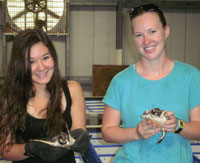 Along the way, we have run into several problems with the equipment. At times, it was extremely frustrating because the turtles and some of the equipment were not cooperating. However, we were able to overcome these problems by cleaning the equipment and replacing a few small parts. Other times, it merely took a few calls to the manufacturer to find out the root of the problem. Life wouldn't be exciting without a few glitches right? That's the motto I have come to live by down here because you just don't know what's going to happen next.
The second week I was here, Assistant Professor of Marine Biology Dr. Bartol came down to provide some aid with the research. It was an eye opening experience. She had a lot of small tricks that made training and collecting the ABRs much easier. During her stay, she also shared some of her previous experiences in the field. I definitely have a new found respect for researchers and those that have their PhD's. They certainly put in a lot of blood, sweat and tears and their dedication is something to yearn for.
I have already learned a tremendous amount; not only about sea turtles but also about ABRs and the various equipment we have used around the lab. This mainly comes from the many responsibilities I have here. They range from cleaning and replacing the canister and filter socks, to preparing squid (my absolute least favorite job), from turning on and checking our equipment to handling the turtles, as well as coming up with clever and innovative ideas needed to help the research run smoother. At times it seems daunting and although it is very labor intensive and mentally draining, at the end of the day, it's very rewarding.
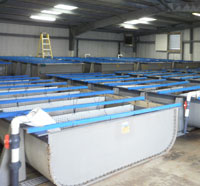 On Friday, we packed up 18 turtles to be released on the East Coast. We have been waiting for the exact date for several weeks now but nothing could be made certain because of the effects of the oil spill. It was very interesting to learn the process by which turtles had to be packed in order to ensure their safety as well as their health. It went smoothly and quickly, which was nice for change. I have to say, it was sad to see some of the turtles go because I had worked with them and you get used to seeing them every day. I just hope that they can make it on their own in the wild.
I haven't had a chance to see much of Galveston yet but from what I have seen, it is beautiful. My favorite part is the historic section. The Strand, which is a well-known street in the historic section, houses many things such as shopping, bars, live music, entertainment and art. It's a fun place to be. We have gone shopping there a few times. It has quite a few cute shops that have a wide variety of merchandise. This past weekend, we met up with other NOAA workers and several of Ashley's friends for dinner and a night out on the town. It was nice to get out and meet new people. We really enjoyed each other's company. We actually got to see an artist known as "The Spray paint Guy." He paints pictures using spray paint, aluminum cans/tops, poster board, and old magazines. He was very talented and several of us purchased his artwork.
Thursday, July 1
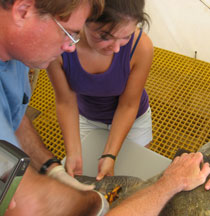 It's been a while since I last wrote and that's because we have been incredibly busy. Last week just flew by. We got booted from our office space in the main building and moved into a camper on site. Another researcher and his staff are coming in to study the effects of the oil disbursement. All in the name of science, right? It's taking a little adjusting to the new arrangements, but we are making it work. To make it more comfortable (and safer) for us, they have built us a walkway which I affectionately call "the red carpet." On Monday and Tuesday, we continued to train the turtles. We made great progress – so much that we were able to complete three training sessions for each of the 13 turtles in order for us to narrow down our list to eight turtles which we can train every other day. However, from Wednesday on, the week slowed down significantly. The turtles were not cooperating, which made the training sessions long and grueling. Needless to say, it was a very long day. On Thursday and Friday, not only did we have some bad weather, but we also ran into some equipment issues and had to visit several electronics stores to come up with solutions. At times it was frustrating because Ashley and I have limited knowledge about detailed electronics; however, in the end, we found a solution and learned a great deal. The old saying is true – you really do learn something new every day.
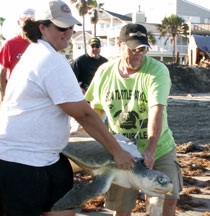 Since we ran into such a standstill toward the end of the week, I worked a half day on Saturday. No matter how much we accomplished it seemed like there was always something else that had to be done before we got started. That being said, my half day got turned into a full day. Not long after making that decision, staff members from NOAA brought back a nesting Kemp's Ridley. Since I have never seen a nesting female or an adult Kemp's Ridley, I jumped right in when they needed a hand. I got to help Ben Higgins, Research Fishery Biologist with the National Marine Fisheries Service at the NOAA Galveston Laboratory, apply the flipper tag. I was also right in the middle of the action when Dr. Flanagan, Houston Zoo's veterinarian, performed an ultrasound and took blood samples to be tested by staff members at Texas A&M University – Galveston. Then I was able to watch as they took various other samples as well. According to the staff, she laid 96 eggs that were collected on the beach and during the ultrasound we saw that she still had more follicles. They named her Lafitte after a pirate that is legendary on the island because she was found nesting on Pirate's beach. Lafitte is a very hearty turtle. She had a few chunks of flipper missing, a gash in her carapace, and suffered a severe eye injury. To top it all off, I was able to watch as the satellite tag was placed on the turtle and her release. You can follow her movement at this link. It was very exciting to be right in the middle of it all and definitely made our grueling 12 and a half hour day worth it.
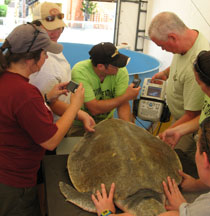 This week started off slow, as we organized our camper, cleaned our tools, updated feed logs and analyzed data. It was a much needed break from the daily grind. Tropical storm Alex, which is now, Hurricane Alex, hit land in south Texas and Mexico on Wednesday night. Luckily we did not get hit. On the other hand, we have been experiencing awful rain fall and heavy winds. This is extremely aggravating. This dramatically slows down training sessions because the turtles act erratically due to the change in pressure. In addition to the erratic behavior, we must also pause during periods of heavy wind and rain due to the increased ambient noise; as if we don't have enough to compete with as it is. Oh well, somehow, we managed to get through another round of training on half of the turtles. Tomorrow, we will complete the training session on the last four turtles. Today, NOAA also received a call about a stranded turtle. Since Ashley and I had to break due to the weather, we went on the call with the staff. When we arrived, a family had found a beached juvenile Kemp's Ridley. He was in bad shape when we picked him up – very slow response rates and he was making odd head movements. The staff immediately put him in sick bay and gave him some antibiotics until he can be taken to the vet in the morning. I am happy to report that at the end of the day, he was slowly making his way around the tank and the odd head movements had decreased some. The staff believes that because he was covered in algae that he was been sick for some time and that his bizarre head movements are either caused by parasites or a near-drowning experience in the storm. Although it is unlikely, we are all hoping that the weather will clear and we will have a nice weekend were we can get out on the town and celebrate the holiday. Happy (early) Fourth of July everyone!
Monday, July 12
I am glad to report that the Holiday weekend went well and that the weather held out for the most part. Ashley's boyfriend, Paul, was in town so he came into work with us for a little. He helped me train the turtles. It was really nice to have an extra set of hands and some comic relief along the way. He caught on quickly and seemed to have a good time. On Saturday went to the beach (which is where I spend all of my free time! ) with some friends to give him a feel of the area. He also got the grand tour of the town later that day. Ashley and Paul cooked an amazing meal for us that night in celebration of the holiday. We lucked out on Sunday with an entire day of sunshine and needless to say, I was lobster red when I returned from the beach at dinner time. I learned my lesson… you must reapply sunscreen if you are going to spend six hours on the beach!
On Monday, we returned back to training so we were up early to prep squid and beat the morning traffic which causes a tremendous amount of ambient noise. There isn't much to report other than we broke our personal record and got through training with seven turtles. I think that this is our most productive day thus far during my stay here. Shelley, a NOAA staff member, brought in a juvenile green sea turtle with a hook lodged in its tongue. Ashley and I were intrigued by this and asked Ben if we could watch the removal. He agreed and as it turned out, we needed four sets of hands to restrain the turtle, secure the beak in the open position, cut and remove the hook. Since I was holding the beak open with string, I was able to get a clear view of the inside of the beak. We don't interact with the greens as often so it was really neat to finally get a close-up view of the beak as well as be a part of the hook removal. Unfortunately, I do not have pictures because Shelley is out of town. However, when she returns I will submit them so you all can take a look.
Tuesday, we started really early again with training. Then we drained, cleaned and refilled the tanks. I worked on repairing the underwater speaker cage as well as removing the rust. Afterwards, I cleaned filter socks. Over the weekend, due to the rough seas the past week, NOAA had received numerous stranding calls. Before the turtles can be released, they have to be cleared by Dr. Flanagan. Ben agreed to let me drive to the Houston Zoo with him to have the turtles checked out. While there, all the new turtles were x-rayed and the turtles that needed fluids received them. The zoo is impressive and it was interesting to see all the equipment and surgery rooms. Sadly, we couldn't stay long because Ben and I both had other things that were more pressing. Hopefully before I leave I will get to go again and get some more exposure. After we had ended for the day, Shelley got a call for a stranded turtle. Since I had only been out on one stranding call, I went with her. It turns out that it was the dead Kemp's ridley that NOAA had been receiving calls about all weekend. When we got there, the turtle was completely bloated. We took the necessary measurements and pictures and bagged the turtle to be brought back to the facility as a necropsy would have to be performed later to determine the cause of death. As we were bagging the turtle, blood and maggots poured out of its mouth. Let me try to describe the stench. It's awful. Imagine rotting flesh and add rotting flesh treated with sea salt. It's unimaginable. Thank goodness I did not have to witness or partake in the necropsy.
Wednesday we resumed training and battled with the occasional rain storm. Training is exhausting, but it's very rewarding at the end of the day when we have finished all the turtles. On Thursday I modified and constructed a new harness for collecting ABR's on different sized animals. This was time consuming. I was limited to where I could layout my supplies seeing as how the weather would not let up and we were forced to endure several intense storms. However, once I set out to work and figured out my measures, the process went quickly. I also worked on modifying the electrodes to be used on the different sized turtles. I thought this would be a simple, quick task… clearly, I was wrong. It is extremely arduous and requires a delicate touch. Needless to say, I had to practice quite a bit. It seems like I am learning a new skill daily and along with those skills, my patience is also being tested.
Ashley came down with some sort of flu-like virus earlier in the week and was a trooper and pushed through. However, it really caught up to her on Thursday and we decided to take Friday off to rest and recuperate. It turns out that we made a very wise decision as I started to feel the effects early Friday. It absolutely drains you of all energy and leaves you feeling just plain crummy. Due to the severity of our symptoms, we didn't work again on Saturday. However, we were not unproductive. We ran errands for the project and problem solved in between naps. On Sunday, we tried out my newly constructed harness and collected ABR's from a different species. I am sad to say that within 15 minutes my harness was torn to shreds, but we were able to salvage it enough to collect ABR's. Although I was upset that all my hard work had been ruined, it was a learning experience and at least now I have a template to work with this time. Now we just have some more brain storming to do later this week! Hopefully this week will be calmer and I will have another update for you all on Friday.
Tuesday, July 20
 We started off the week by switching gears from ABRs to behavior. We went back to training sessions because Ashley wanted to confirm that we had picked the most competent turtles. After some talking, we decided that we would continue to split up the shifts in order to avoid ambient noise. It makes the training sessions go smoother and much faster, thus, alleviating some of the frustration and stress on our end. It was a long day, needless to say. I have quickly learned that caffeine is an absolute necessity with this project.
On Tuesday, we resumed training the turtles. We also drained the tanks, cleaned and refilled them. I worked on cleaning the filter and fill socks. We also began setting up for trials. We were lucky enough to get to tag along on a nesting call. When we finally located the tracks, which were difficult to find, we all piled out of the truck. The Texas A&M team members measured and photographed the tracks and they concluded that it was most likely a nesting loggerhead! That is exciting news because they haven't had a recorded loggerhead nesting in at least a year. After properly documenting everything, we went to work digging up the nest. Ashley and I snapped a few "action" shots and then dug right in, literally! We dug for two and half hours. We came up empty handed. Ashley and I needed to get back to the apartment to rest before our night shift, so we sadly had to leave. However, we later caught up with the Texas A&M team members. They dug for another 2-3 hours and sadly could not find the eggs. They believe it was a false crawl and that someone or something scared her off. Everyone was really bummed.
Wednesday, we worked with the second group of turtles that had not participated in trials for several days. They needed to have a refresher course, so that took up a large portion of the day. Then I worked on cutting the sailboat grade canvas into the template that we needed. We ran various errands for the project including finding a new material that could withstand constant water submersion and would be durable enough for the use with turtle. This was quite the task. We ended up buying sailboat grade canvas. The next problem that we had to overcome was what kind of adhesive would stick to the fabric and the industrial strength Velcro, but was still waterproof and secure. After looking into several options, we decided to try gorilla glue. We took some time off to eat and get some sleep and headed back to work in the evening to finish up more training.
Thursday was our big day. We started really early – around 5 a.m. and worked until the ambient noise became too much of a nuisance. Then we switched gears for a while and worked on updating the environmental feeding logs for NOAA as well as our own data sheets. I also worked on gluing the Velcro onto the harness and making sure it worked and was secured. After an extremely long, but productive morning, we took a break for the afternoon. In the evening, we resumed working on trials again.
On Friday, we tried out the new harness on a different species. Thankfully, the canvas held up much better than the original fabric. Success! We were both really excited that we got the turtle in the harness and it was durable, that we jumped right into collecting ABRs. It took a little longer than we had wanted it to; but in the end, we concluded that we had been really productive and it was worth a little extra time. Afterwards, I cleaned the filter socks and all of our equipment. We also bleached everything in the Longline building to get rid of the awful squid smell. It was well worth the time spent.
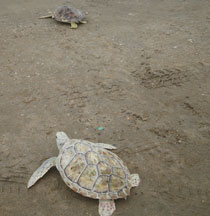
Ashley went home to be with her loved ones for a long weekend. It was time to have some extra time off work to sleep and relax. I got to catch up with some of the other interns working for NOAA. We went out to dinner and saw Inception. It was an amazing movie! The next day, we went out to lunch again and hung out by the pool because it was so overcast. It was exactly what I needed since my body hasn't adjusted to working two shifts yet. It was also a nice break for my hands, which are peeling, splitting and cracking due to being in contact with salt water for prolonged periods of time. It's very unpleasant and quite painful. They didn't heal completely, but salt water free days are a plus in my book! Although I didn't work on Monday, I went with some of the staff members to release some of the greens that were in sick bay and had been recuperated. It was quite an experience to see them released. One of the greens took off towards the water; whereas, the other turtle hung around the water's edge for a little while. Eventually, he took off and we said our goodbyes. I thought my day was going to end there; however, I tagged along for the rest of the survey that is done every Monday. One of the staff members, Lyndsey, performed a necropsy on a subjuvenile hawksbill. Poor little girl barely had any muscle and nasty lung infection. Due to the state of the turtle, I was able to see all the organs clearly. I was also shown how to identify a male from a female. Later, the turtle was buried on the beach. On Sunday, an 80 cm female loggerhead was brought into the facility. She had been hit by a boat and was damaged severely. When they found her, she was still alive and breathing! No one can believe it. Due to the severity of the wounds, she had to be euthanized. Lyndsey also performed the necropsy on this turtle prior to the survey and we also buried this turtle on the beach. She was one of the biggest loggerheads I have seen and terribly malformed: one of her foreflippers had been torn off and most of her head and upper beak here missing because of the boating accident. To make matters worse, she had been nibbled on by a shark while coming ashore. Talk about bad luck. Everyone is wondering how the oil spill will affect the number of turtle strandings like this one in the Galveston area, as more shrimpers are working their way into the area. Hopefully, the numbers will not increase and there are not any more casualties like this.
Wednesday, July 28
Working split shifts for over two weeks has finally taken its toll on Ashley and me. We both have overslept because we are both exhausted. Although we both try to sleep in between shifts, it's hard to switch gears so quickly, even if one is running ragged. Not only is it very difficult to sleep soundly at our apartment due to all the passing automobiles and planes, but also the fact that our neighbors are not very quiet. It makes working long and difficult hours even more trying and at the end of each shift, we can barely speak coherently although I'm sure it would be quite humorous for others to hear. The morning shifts begins anywhere from 4 to 5 a.m. and last until about 9 or 10 a.m. This includes set-up, clean up and behavior trials or ABRs. During the day, in between naps, we update environmental logs, verify SPLs (sound pressure levels), analyze and verify data, as well as update behavior logs, transfer video files and keep up on paperwork. The night shift begins anywhere from 6 to 7 p.m. and last until 10 or 11 p.m.
As a rule, we drain, clean and refill the tanks once a week since there are large quantities of squid being consumed in the tanks and as a result, the turtles defecate quite frequently. Thus, on Tuesday, we drained the tanks, rinsed and cleaned them and began the process of refilling them. While we were waiting for the tanks to fill, I entered and verified the behavior training and trial logs, updated data sheets and updated NOAA environmental logs. I also learned how to move the video files from the behavior trials to the external hard drive which I will later go back in, organize by date, turtle and SPL level. We also installed the cards in our new chassis and verified that it was working correctly. Thankfully, it was! Later that day, we also prepped squid for the trials we would be running early the next morning.
Wednesday, we ran trials on several turtles. Trials are time consuming. We continue on with trials until the turtle is no longer motivated or until there is too much ambient noise. Just to give you an idea of how long trials take, with every trial our aim is to get through a warm up and four additional blocks. Each block consists of multiple replicates at a specific SPL. If the turtle is motivated, cooperative, the weather is fair and there is little ambient noise, it takes at least two hours to run a warm up and three blocks. When we were done trials, we cleaned up and set up as much as possible for the next day.
Thursday, we ran ABRs on two of the larger loggerheads. This proves to be quite the task. They are large and upwards of about 50 pounds. Thus, it is very time consuming to lift the turtles out of their raceways, onto a cart, into the harness and take them into the Longline building. On a good day, that takes about 20 minutes for Ashley and I do it ourselves. Then, Ashley has to insert the electrodes. Of all the tasks we perform, this has to be the single most time-consuming feat and it single-handedly the most frustrating. I cannot even begin to tell you how many electrodes are bent during this process. And the best part of this whole experience? The turtle is jerking its head/body around, you are trying not to get bitten/stab yourself with the electrodes/avoid bending the electrodes and the sweat is just pouring off you, running into your eyes and makes gripping anything twenty times harder. Okay, so I am aware I made that sound awful but I don't think I have described in detail any of the procedures we go through on a daily basis. Now that I have officially scared some of you with the difficulties of research, I feel like I can tell you that it's really not that bad once you get used to it, but let me tell you all, some days it is immensely frustrating. If the turtle thrashes around… well, let's just say it takes entirely too long. However, most days, the turtles calm down quickly and everything goes smoothly, it usually only takes 30 minutes to an hour. Once the electrodes are inserted, the turtles are placed in the tank and we begin collecting ABRs. To get a full set of data when there is little ambient noise, it takes about four hours. If we have to continually run SPLs due to ambient noise and the turtles thrashing as a result, then the time significantly increases. My job while ABRs are being collected is to let Ashley know when there is ambient noise or when the turtle is moving around too much, so we can pause. I also monitor the turtles breathing to make sure they aren't getting too stressed out. I frequently check the electrodes to make sure they are still in place. I also make sure the turtles are not biting the electrode leads or the hydrophone and that they are still securely in the harness.
On Friday, we continued on with trials with two turtles in the morning. Afterwards, I did a thorough clean of the Longline building with bleach to eliminate the presence of ants and cockroaches who like to visit me during our early morning/late night adventures. Early afternoon and after lunch, we continued to update environmental data sheets for NOAA, our own data sheets, and behavior trial logs. Then I verified them. I also assisted Ashley in preparing and reviewing the expense report. Since we had started the day so early, we ended late afternoon and ran various errands for the apartment.
Saturday, we worked for several hours in the early morning. We ran trials on two of the turtles. Then we cleaned up and headed home for the rest of the day to nap, catch up on logs and keep in touch with friends and family which is increasingly difficult to do because of our schedules. Later that evening, I spent some time catching up with an intern in another branch of NOAA since she is leaving at the end of this week. Later that evening, Ashley and I decided we were totally exhausted from the week and that having one day to sleep in and some serious REM sleep under our belts would not only be of advantage to ourselves but to the project, we even took Sunday off to rest and catch up.
On Monday, we realized we were more exhausted than we thought. We overslept…again. However, in the end it worked out just fine since thunderstorms started around 3:30 a.m. and persisted until about 6:30 a.m. To make good use of our time, we updated the behavior logs, verified them, and analyzed the ABR data we collected on Friday. I verified SPL levels and recorded the data accordingly. Then, we napped and prepared for trials later that evening. We worked with two turtles again. While we were working, Ben returned from Florida with about 200 loggerhead hatchlings. They are so tiny and are absolutely adorable! Hopefully in the days to come, I will have some time to get some pictures.
Tuesday, we ran more trials in the morning. However, we fought with storms and an immense amount of ambient noise once again and continued on with our efforts from Monday. We also drained, cleaned and refilled the tank. We updated and verified more logs, updated NOAA environmental logs and moved behavior trial videos to the external hard drive. Later that evening, we resumed trials. We ran into some issues with changes in pressure due to an incoming storm and learned just how severely sensitive our equipment is. However, after some minor adjustments, we were able to continue on with trials. We prepared more squid for trials the next morning.
Today, Wednesday, Ashley and I both got up super early and were just about to walk out the door, when we witnessed a small hurricane. Okay, so maybe that's a bit of an exaggeration but it was a torrential downpour with strong gusts of wind. It showed no signs of clearing up any time soon and we checked the weather. Since there was no way of carrying out trials this morning, we went back to bed for a few hours. Later in the morning, we headed to work to feed the turtles. Of course, it was still raining, but we headed to the camper to analyze more data and update data sheets and logs. Since we will be resuming ABRs either tonight or tomorrow, depending on the weather, I shortened and sharpened more electrodes to be used on some of the smaller turtles. The video files from last night will be transferred to the external hard drives. Later this evening we will resume either ABRs or trials.
I've learned quite a bit during my two and half months here. I've learned that research is hard -extremely hard. You aren't always going to be working under great conditions (weather/ambient noise). You have to be extremely flexible to work around such conditions. I've learned that there are many obstacles to be overcome and one has to be open minded to new ideas and opportunities. Some days you just have to accept defeat but you do your best regardless. You go to bed knowing that somehow tomorrow will be better. I've learned that frustration is waiting around every corner… you just have to gather up all your patience and push through. I've also learned that in order to do research, one must be immensely motivated and dedicated. I feel like this experience has truly prepared me for my future research projects.