

By Suzanne Savage | October 15, 2010
and Megan Z. Shearin
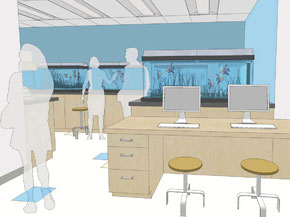 Norfolk/Virginia Beach, Va. – Virginia Wesleyan College has been awarded a $621,507 grant from the National Science Foundation (NSF) for the “Strategic Modernization of Undergraduate Research Facilities in the Sciences.” The award is funded under the American Recovery and Reinvestment Act (ARRA) of 2009.
The grant will allow Virginia Wesleyan to undertake a significant modernization of six dedicated research labs and three joint research/teaching labs in Blocker Hall, creating a modern research space with cutting-edge technology. Blocker Hall, the College’s only science facility, was constructed in 1970.
Batten Professor of Biology Dr. Vic Townsend, who served as the faculty lead on the grant, said the funding will help dramatically transform research opportunities for undergraduates and faculty at Virginia Wesleyan.
“The renovation of dedicated research labs and joint research and teaching labs in Blocker Hall will usher in a new, exciting and dynamic era in undergraduate research and faculty scholarship in the natural sciences at Virginia Wesleyan,” said Townsend.
Renovations to the facility will also significantly increase the quality of faculty research and undergraduate research training by enabling student investigators to address more complex research questions, thus broadening the scope of their activities. Modernized research labs will diversify and enhance hypothesis-driven research and promote faculty grant-writing activity with respect to research activities.
“For this small, liberal arts college to be recognized by the National Science Foundation tells us that people know where we are academically and that we are about the task of being engaged in quality academic pursuits,” said President Billy Greer. “We have seen a renewed interest in the natural sciences and this grant is symbolic of that movement. I am very proud of everyone across campus that made this grant possible.”
Three existing joint research/teaching labs, including the General Biology, General Chemistry and Environmental Science Laboratories, will have significant upgrades to electrical, plumbing, lighting, temperature control and ventilation systems. Classrooms will also be reconfigured to encourage student collaboration and increased student/teacher interaction. The addition of lab benches and work spaces will create a more efficient learning environment.“The NSF grant is a double bonus for Virginia Wesleyan: first, it recognizes the very high quality of our faculty and undergraduate research program; and, second, it will provide new facilities that will enhance the scope of our program.” – Vice President for Academic Affairs Dr. Timothy O’Rourke
The College will acquire several pieces of modern research instrumentation to equip the renovated dedicated labs, including the Spectroscopy, Electron Microscopy, Freshwater Ecology, Chromatography, Mercury Analysis, and Chesapeake Bay Laboratories. The Chesapeake Bay Wet Lab will be substantially enhanced, a reflection of both the College’s close proximity to the Chesapeake Bay and Atlantic Ocean, and recent integration of student experiences aboard the Ocean Explorer research vessel into the science curriculum. For labs with instrumentation, upgrades will also include replacement of electrical, plumbing, lighting, temperature control and ventilation systems.
Research training efforts will dramatically improve for students majoring in biology, chemistry, and earth and environmental sciences, thanks to the renovations. Over the past five years, the College has seen a significant increase in students pursuing science majors, thus creating limited space to conduct independent, hypothesis-driven research. The new renovations will double research training capacity, enabling the natural sciences to support up to 52 student research projects each year.
Vice President of Operations and Project Manager Bruce Vaughan said the modernizations will have a profound effect on the visual and functional serviceability of these research spaces. “Our students will be much better prepared for the next step in research,” he said.
With a diverse student body of roughly 1,400 students, 31% of natural science majors are minorities. As a consequence of improvements to the infrastructure, the natural sciences will increase quality research training opportunities by more than 100%. This will especially impact the participation of historically underrepresented groups undertaking independent research projects in the natural sciences. Graduates from the College who participate in research training will be more competitive for admission into graduate and professional programs and will enhance their preparation for careers in natural sciences and science education.
Congressman Glenn Nye, who represents the 2nd District of Virginia, said he is incredibly pleased that Virginia Wesleyan was successful with the NSF Grant.
“It shows that Virginia Wesleyan will play a continued role in training our next generation of scientists, propelling our nation forward,” said Nye. “I will continue to push to ensure that our education facilities are top notch and our communities are getting their share of federal dollars.”
The NSF ARRA grant enables the College to move forward on Phase II of a $2.8 million modernization of Blocker Hall. Due to the need to conduct the modernization of Blocker Hall when classes are not in session, the renovation was designed to be implemented in two phases over the course of the summers of 2010 and 2011. The first phase, costing approximately $1.4 million, was completed in time for the fall 2010 semester. This phase focused on the renovation of the Advanced Chemistry Lab and Chemical Storage Room, the Physics/Geology Lab and the Molecular Biology Lab.
The NSF is an independent federal agency that supports fundamental research and education across all fields of science and engineering, with an annual budget of roughly $6.9 billion.
###